
Are Modal Silk Hair Ties Worth It? A 2026 Guide
· Editorial Team

Table of Contents
- Are Modal Silk Hair Ties Worth It? The Honest Answer
- Silk vs. Modal Hair Ties: What Actually Changes
- Least Damaging Hair Ties for Hair: What the Evidence Supports
- Hair Ties for Curly Hair: Hold, Stretch, and Pressure Distribution
- How to Wash Silk Hair Ties Without Ruining the Fabric
- The Real Cost of Modal Silk Hair Ties: Price, Lifespan, and Cost Per Wear
- Who Should Skip Modal Silk Hair Ties (and What to Try Instead)
- Conclusion: When Modal Silk Hair Ties Earn Their Place in Your Routine
- Frequently Asked Questions
Last Updated: October 5, 2026
Are Modal Silk Hair Ties Worth It? The Honest Answer
Modal silk hair ties are worth it if your priority is reducing friction, tension, and creasing on delicate hair without paying for pure mulberry silk. They are not worth it if you want a rock-solid grip for high-intensity workouts or the cheapest option per tie.
Below, we break down how modal fiber actually differs from mulberry silk, what it means for breakage and frizz, how to wash them, and how cost per wear stacks up.
Silk vs. Modal Hair Ties: What Actually Changes
The main difference between silk and modal hair ties comes down to fiber origin and finish, not just price. Mulberry silk is a natural protein fiber produced by silkworms.
Both can be gentle on hair. The variable that matters is the surface: a smooth, low-friction finish reduces snagging, while a rough or exposed elastic edge catches strands and pulls them.
How Modal Fiber Differs From Mulberry Silk
Modal is softer to the touch than standard cotton and holds dye well, which is why it takes hand-dyed color evenly. Mulberry silk has a natural sheen and a slightly cooler feel.
For a deeper look at fiber properties, the Textile Exchange materials overview explains how cellulosic fibers like modal are produced and sourced.
Friction, Smoothness, and Snagging on Real Hair
Friction is the enemy of healthy strands. When a tie drags across hair, it lifts the cuticle and creates the conditions for split ends and tangles. A smooth surface lets the tie slide off with less resistance.
A common mistake is assuming "silk" on a label guarantees low friction. A tightly wound exposed elastic band wrapped in a thin fabric layer can still snag.
Least Damaging Hair Ties for Hair: What the Evidence Supports
The least damaging hair ties share three traits: a smooth surface, even pressure distribution, and enough stretch to avoid tight pulling. Evidence-based comparisons of hair damage consistently point to friction and tension as the two mechanisms behind breakage, rather than any single fiber type.
That reframes the question. Instead of asking "silk or modal," ask whether the tie avoids concentrating force on one spot.
- Smooth surface: reduces snagging as you tie and untie
- Even pressure: spreads tension across a wider band instead of a thin elastic cord
- Moderate stretch: holds without cinching so tight it stresses the strand
- Soft edge: no exposed metal joiners or rough seams
Hair Ties for Curly Hair: Hold, Stretch, and Pressure Distribution
Hair ties for curly hair need a firmer hold and more stretch than fine hair does, because curl patterns create volume that resists compression.
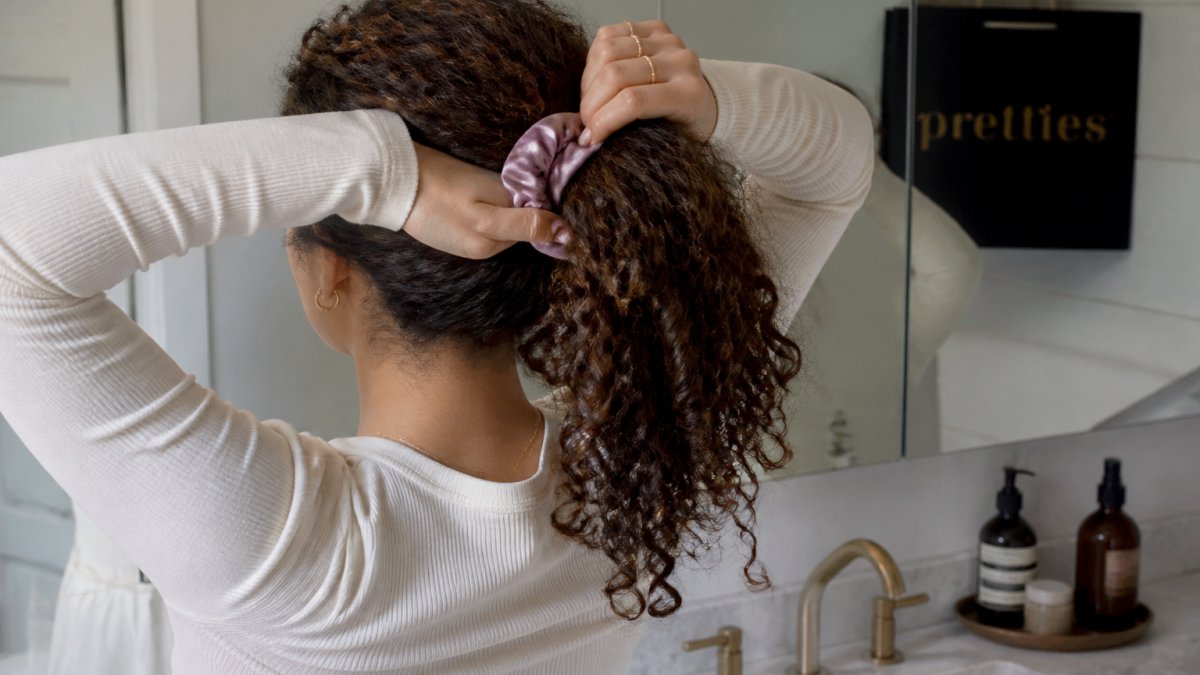
How Hold and Slip Change by Hair Type
Most guides treat "curly hair" as one category, but hold and slip vary widely across fine, thick, curly, textured, and fragile hair. A common pattern is that the same tie behaves differently depending on density, strand diameter, and how much the hair compresses.
- Fine hair: compresses easily, so a thin cord can leave a deep dent. A wide, smooth fabric band spreads pressure and reduces creasing, but the tie must still have enough grip to avoid sliding out during the day.
- Thick or dense hair: resists compression, so a narrow tie has to be wrapped tighter to hold, which concentrates tension. A wider band or a spiral tie that coils through the hair distributes that tension.
- Curly hair: the curl pattern creates natural volume, so a tie that is too tight flattens the curl and a tie that is too loose slips. A fabric-covered scrunchie wrapped two or three times usually holds without crushing the pattern.
- Textured or coily hair: benefits from a smooth surface that slides off without snagging, and from a band wide enough to avoid pulling on individual sections.
Wrapped Fabric Ties vs. Spiral Ties
Wrapped fabric ties and spiral styles both spread tension, but they behave differently. A spiral hair tie coils through the hair and holds without a tight loop, which suits quick, secure buns and thick hair that resists compression.
For thick, damage-prone curls, the wider fabric option is often the more comfortable choice for long wear, while spiral ties suit short, secure styles.
Fit, Sizing, and Slipping
Fit is the variable most people overlook. A tie that is too narrow concentrates force on one spot; a tie that is too wide may not grip fine hair at all.
For exercise or all-day wear, a smooth fabric tie can stay secure if it is wrapped enough times to create even pressure without a tight loop. If you need maximum grip for high-intensity movement, a spiral or silicone-lined sport tie often stays put better.
How to Wash Silk Hair Ties Without Ruining the Fabric
Washing silk and modal hair ties correctly extends their lifespan more than any other habit. The goal is to remove oils and product buildup without breaking down the fiber or fading the dye.
- Fill a bowl with cool water and a drop of gentle detergent.
- Submerge the ties and gently squeeze the water through the fabric.
- Let them soak for a few minutes, then rinse in cool water.
- Press them between a towel to remove excess water.
- Lay flat to air dry, away from direct heat or sunlight.
Skip the washing machine and dryer. For a full set of care instructions, the American Cleaning Institute fabric care guidance covers how to handle delicate fibers at home.
The Real Cost of Modal Silk Hair Ties: Price, Lifespan, and Cost Per Wear
Cost per wear, not sticker price, is the honest way to judge whether modal silk hair ties are worth it. A cheaper tie that stretches out or loses its shape after a few months gets replaced repeatedly, and that adds up. The math is simple: divide what you pay by the number of wears you get before the tie loses its hold, its shape, or its color.
Here is how the main options compare on the factors that decide value.
| Option | Hold | Gentleness | Typical Lifespan | Best For |
|---|---|---|---|---|
| Modal silk fabric tie | Firm, even | High | Long with proper care | Daily wear, delicate hair |
| Mulberry silk scrunchie | Moderate | High | Moderate | Overnight wear, fine hair |
| Satin scrunchie | Moderate | High | Moderate | Overnight wear, fine hair |
| Cotton scrunchie | Moderate | Moderate | Moderate | Everyday wear, thicker hair |
| Spiral hair tie | Firm | Moderate | Long | Curly hair, secure buns |
| Standard elastic | Tight | Low | Short | Quick, low-cost tying |
How Care Changes the Cost-Per-Wear Math
Lifespan is not fixed. It depends on how you wash, stretch, and store the tie. A modal silk tie that is hand-washed in cool water, pressed dry in a towel, and air-dried flat can keep its feel and shape far longer than one that goes through a washing machine and dryer.
A common pattern is that people who treat fabric ties like delicates get months of regular wear, while people who toss them in with the laundry replace them much sooner. That difference is what makes cost per wear swing so widely.
Modal vs. Silk, Satin, Cotton, and Standard Elastics
Each material trades off differently:
- Modal: smooth, durable against repeated washing, holds dye well, and tends to cost less than mulberry silk. It is a strong middle ground for daily wear.
- Mulberry silk: natural sheen and a cool feel, very gentle, but can lose luster over time and often costs more upfront.
- Satin: smooth surface and gentle on hair, but satin is a weave, not a fiber, so durability depends on the underlying material.
- Cotton: breathable and affordable, but rougher than modal or silk, so it can create more friction on fragile hair.
- Standard elastics: lowest upfront cost, but thin cords concentrate tension and tend to stretch, snap, or get lost, which drives repeat replacement.
When you divide the cost by the number of wears a durable tie delivers, the gap between a cheap elastic and a well-made fabric tie narrows considerably. The tie that lasts longer and protects hair often costs less per wear than the multi-pack you replace every few months.
Who Should Skip Modal Silk Hair Ties (and What to Try Instead)
Modal silk hair ties are not the right pick for everyone, and being honest about that saves you money.
Where modal silk ties earn their place is daily, gentle styling: workdays, overnight wear, and any routine where you want to protect hair from dents and creases.
The Pretty Pretties ties add one more layer: microencapsulated essential oils release a natural aroma over time, turning a simple hair tie into a thoughtful and intentional experience.
Conclusion: When Modal Silk Hair Ties Earn Their Place in Your Routine
The honest answer is that modal silk hair ties are worth it when your hair is delicate and your priority is reducing friction, tension, and creasing.
If that sounds like your routine, our hand-dyed, biodegradable modal silk and cotton ties protect against damage and denting, hold firmly for all hair types and textures, and release a natural essential-oil aroma for a calmer start to your day.
Frequently Asked Questions
Are modal silk hair ties suitable for thick or curly hair?
Yes, when the elastic core is strong enough. Modal silk fabric is soft and smooth, so it glides over curls instead of snagging, but hold depends on the inner elastic rather than the outer fabric. Look for a firm, wide elastic band that distributes pressure evenly. For thick or curly hair, a wider scrunchie-style tie spreads tension better than a thin band and reduces the chance of creases or dents forming at the base of the ponytail.
How do modal silk hair ties compare with silk scrunchies?
Both use a smooth outer fabric to reduce friction, but they differ in material and care. Traditional silk scrunchies use mulberry silk, which is delicate and often needs hand washing. Modal silk hair ties blend modal with cotton, giving them more stretch and durability for daily wear and workouts.
How should you care for modal silk hair ties?
Hand wash in cool water with a mild detergent, then squeeze gently and lay flat to dry. Avoid hot water, bleach, and the dryer, since heat breaks down both the modal fibers and the elastic core. If you machine wash, use a mesh laundry bag on a delicate cycle. Rotating two or three ties and washing them every few wears keeps the fabric smooth and extends the lifespan.
Do silk hair ties help prevent hair creases?
They can reduce them, but the fit matters more than the fabric. A tie that sits too tight will leave a dent no matter what it is made of. Modal silk hair ties with a wide, soft band spread pressure across a larger area, which lowers the chance of a visible crease. Removing the tie gently and letting hair settle before styling also helps creases fade faster.
Choosing the right hair tie is really a choice about how you want your hair to feel after a long day. The Pretty Pretties makes that choice easier with hand-dyed, biodegradable ties built from ethically sourced modal silk and cotton, a firm hold that suits every hair texture, and a natural essential-oil scent that lasts. Get started with The Pretty Pretties and give your hair a gentler, more intentional daily ritual.