
Are Expensive Hair Ties Worth It? A 2026 Comparison
· Editorial Team

Table of Contents
- Are Expensive Hair Ties Worth It? The Real Cost Breakdown
- Best Hair Ties for Preventing Breakage
- Silk vs Satin Scrunchies: What the Label Doesn't Tell You
- Best Hair Ties for Thick Hair: Hold, Stretch, and Recovery
- Hair Ties That Don't Leave Dents: Comfort, Tension, and Removal
- Durability and Care: How Long Do Expensive Hair Ties Last?
- Premium vs Budget: A Buying Framework by Hair Type and Activity
- Conclusion: When Expensive Hair Ties Earn Their Price
- Frequently Asked Questions
Last Updated: October 7, 2026
Are Expensive Hair Ties Worth It? The Real Cost Breakdown
Are expensive hair ties worth it? Yes, but only when the price reflects real construction differences rather than branding. Here is what you actually pay for, where budget elastics cut corners, and how to decide based on your hair type and routine.
What You Actually Pay For
A premium hair tie is a construction decision before a style decision. The money goes into materials, finishing, and elastic recovery.
- Fabric covering. Fabric coverings sit between the elastic and your hair, reducing friction at the point where strands normally snap.
- Seamless or bonded construction. Metal crimps and glued joints catch hair. Bonded or sewn closures do not.
- Elastic recovery. Better elastics return to their original shape instead of stretching out after a few weeks of wear.
Cheap hair bands are made to hit a price point, and something has to give.
Cost Per Use: The Number That Matters
Cost per use is the purchase price divided by the number of wears before the tie fails. A $40 set of five ties at $8 each, worn 200 times, costs about $0.04 per wear; a $5 bag of twenty elastics at $0.25 each, worn ten times, costs about $0.03 per wear, and usually breaks hair along the way.
| Option | Price Per Tie | Typical Wears | Cost Per Wear | Hair Impact |
|---|---|---|---|---|
| Budget drugstore elastics | $0.25 | 5-10 | $0.03-$0.05 | Snagging, creasing, breakage |
| Mid-range fabric ties | $2-$4 | 50-100 | $0.03-$0.06 | Less snagging, some creasing |
| Premium hand-dyed ties | $8 | 150-300+ | $0.03-$0.05 | Minimal snagging, no dents |
The real difference is not the pennies. It is the condition of your hair after a year of daily wear.
Best Hair Ties for Preventing Breakage
The best hair ties for preventing breakage are fabric-covered, seamless, and gentle enough to slide out without pulling. Breakage rarely comes from the tie itself, it comes from friction, tension, and removal.
What Causes Breakage in the First Place
Three things do most of the damage:
- Friction. Bare elastic grips strands and drags them as you wrap. The cuticle lifts, and the strand weakens at that point.
- Tension. A tight wrap pulls the hair at the root. Over months, that stress shows up as thinning along the hairline.
- Removal. Yanking a tie out is the single most damaging moment of the day. Fabric ties slide off with far less resistance.
The Controlled Comparison: Where Damage Shows Up
To compare fairly, hold everything constant except the tie: same hair, wash routine, and wears per week.
- Week 1: Budget elastics leave a visible crease after two hours. Fabric ties leave a soft indentation that fades within minutes.
- Week 4: Budget elastics show stretched loops and lose hold by midday. Fabric ties still recover their shape.
- Week 12: Budget elastics leave broken strands around the wrap point. Fabric ties show minimal breakage when removed gently.
The pattern is consistent: damage accumulates slowly with budget elastics and stays low with fabric-covered ties.
Silk vs Satin Scrunchies: What the Label Doesn't Tell You
Silk and satin are not the same material, and the label rarely makes the distinction clear. Silk is a natural protein fiber; satin is a weave structure that can be made from silk, polyester, or cotton, and the two behave differently against hair.
- Silk is naturally smooth, breathable, and gentle on cuticles. It also costs more and needs careful washing.
- Satin describes how the fabric is woven, not what it is made from. Polyester satin is cheap and smooth but traps heat and holds static.
- Cotton and modal blends absorb less friction than bare elastic while staying breathable and machine-washable.
For hair health, the weave matters less than the fiber. A cotton-modal blend with a smooth finish does most of what a silk scrunchie does, at a lower price and with easier care.
Best Hair Ties for Thick Hair: Hold, Stretch, and Recovery
The best hair ties for thick hair combine a thicker elastic core with a fabric covering that grips without cutting in. Thick hair needs more stretch and surface area, and most budget elastics fail on both counts. Three features decide whether a tie holds:
- Elastic core thickness. A thicker core resists the tension of a full ponytail without thinning out.
- Stretch range. The tie needs enough give to wrap two or three times without pinching.
- Recovery. After the stretch, the elastic must return to its original size. Ties that stay stretched out stop holding within weeks.
For ponytails, buns, and braids on thick or long hair, a fabric-covered tie with a firm core holds better than a thin elastic loop and distributes pressure across a wider band, reducing pull at the hairline.
Our Uplift set in all black uses a firm-hold construction that the brand tested for movement during vigorous activity, so it stays put through a workout.
Hair Ties That Don't Leave Dents: Comfort, Tension, and Removal
Hair ties that don't leave dents spread pressure across a wider band instead of one narrow line, so the hair underneath keeps its shape.
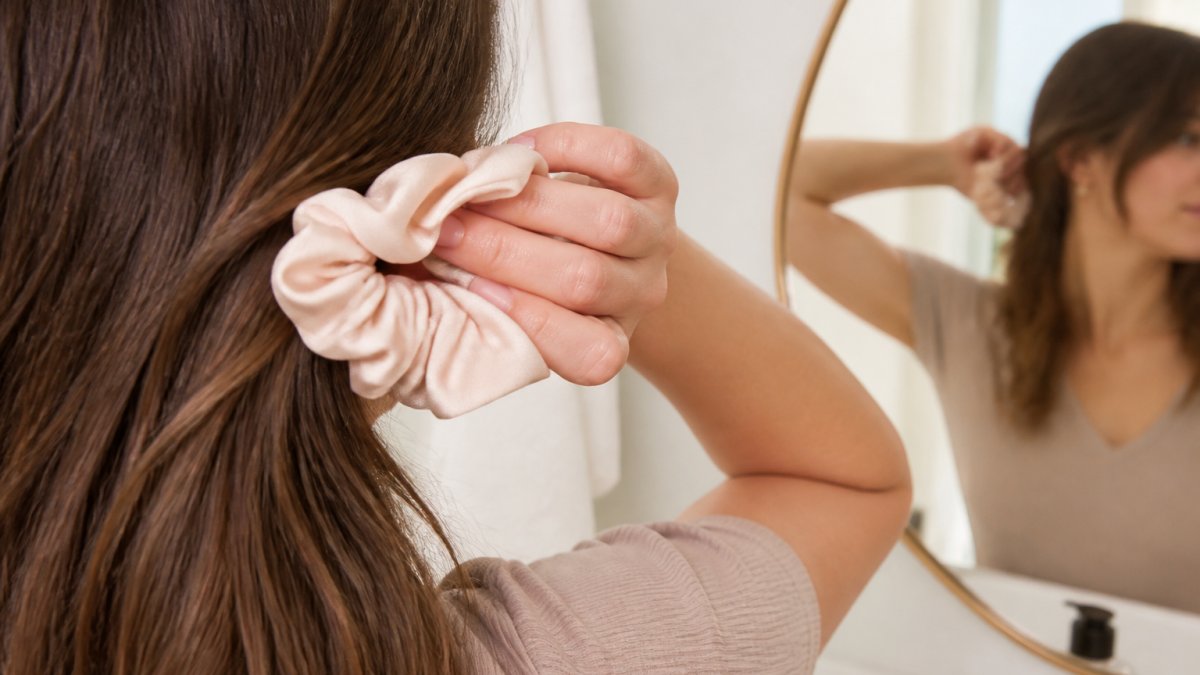
Comfort during all-day wear comes down to three things:
- Width. A wider band spreads tension and reduces the crease line.
- Fabric softness. Smooth fibers slide against hair instead of gripping it.
- Wrap count. Two wraps hold most hair without overtightening. Three wraps on thick hair is usually one too many.
Removal is where cheap ties lose the argument. A bare elastic grips and releases with a snap; a fabric tie unwinds and slides free, the moment most breakage happens.
Durability and Care: How Long Do Expensive Hair Ties Last?
A well-made fabric hair tie typically lasts six months to a year of regular wear, longer if you rotate between several. That range is only useful if you know how to measure it yourself.
A Transparent Test Method You Can Repeat at Home
To compare any two ties fairly, hold everything constant except the tie, same hair, wash routine, and wears per week, then track four things:
- Elastic recovery. After each wear, lay the tie flat and measure its relaxed length against a ruler. A tie that returns to within a quarter inch of its original length is recovering well. One that stays stretched out by half an inch or more is losing hold.
- Seam and closure integrity. Check the bonded or sewn joint after every wash. A closure that frays, separates, or exposes the elastic core is a failure point that will catch hair.
- Fabric covering wear. Look for thinning, pilling, or exposed elastic at the point where the tie wraps. Once the core is visible, friction against hair increases.
- Snap point. Note the wear count when the tie breaks or stops holding a ponytail without extra wraps. That number is your realistic lifespan.
A common pattern: mid-range fabric ties fail between 50 and 100 wears, and premium hand-dyed ties between 150 and 300 or more, depending on hair thickness, wrap count, and wash frequency.
Pretties Scented Hair Ties | 100% French Lavender Essential Oils | Pk of 5 →
What Actually Shortens Useful Life
Elastic recovery is the first thing to go, and heat is the fastest way to destroy it. Hot water, dryer heat, and leaving a tie stretched around a hook all accelerate breakdown of the elastic core. Fabric covering wears out next, usually at the wrap point. Seams and bonded closures fail last on well-made ties, but first on cheap ones.
Care Steps That Extend Lifespan More Than Price Does
- Wash by hand in cool water with a mild soap. Hot water breaks down elastic.
- Air dry flat. Dryer heat is the fastest way to kill elastic recovery.
- Rotate your set. Wearing the same tie every day wears it out faster than cycling through five.
For scented ties, storing them in a closed case helps the essential oils last. Our Lavender set ships with a custom purple travel case that keeps the ties contained and the scent concentrated between wears.

Premium vs Budget: A Buying Framework by Hair Type and Activity
A useful framework starts with cost per use, then matches the tie to your hair type and activity.
Start With Cost Per Use, Not Sticker Price
Cost per use is the purchase price divided by the number of wears before the tie fails. A $40 set of five ties at $8 each, worn 200 times, costs about $0.04 per wear; a $5 bag of twenty elastics at $0.25 each, worn ten times, costs about $0.03 per wear. The gap is smaller than most shoppers expect, what changes is the condition of your hair after a year of daily wear.
Performance by Hair Type and Activity
| Hair Type / Activity | What to Look For | Why |
|---|---|---|
| Fine or delicate hair | Smooth fabric, no metal crimp | Reduces snagging and breakage |
| Thick or long hair | Thicker elastic core, wide band | Holds without overtightening |
| Curly or textured hair | Seamless fabric, gentle removal | Prevents tangling and shape disruption |
| Daily workouts | Firm-hold construction | Stays put through movement |
| All-day office wear | Soft, wide, seamless band | No dents or pressure points |
| Overnight or travel | Gentle fabric tie, compact case | Protects hair while you sleep |
When a Basic Tie Is Enough
A basic tie is sufficient if you lose ties constantly, tie your hair up occasionally, or buy in bulk for a shared household or gym, you are not wearing them long enough for the hair-condition benefit to compound.
When Paying More May Be Worthwhile
Premium ties earn their price if you have fine, delicate, or color-treated hair prone to breakage, wear a tight hairstyle daily, want ties that hold through cardio without slipping, or care about biodegradable materials and ethical production. They are perfect for gifting.
The Unique Angle: Comfort, Tension, and Removal Trade-Offs
A stronger hold is not automatically better for your hair. A tie that grips tightly enough to stay put through a workout can also create tension at the hairline and make removal harder.
Three trade-offs to weigh:
- Hold versus tension. A wider band distributes pressure and reduces the pull at the hairline, even when the tie feels secure.
- Grip versus removal. A fabric tie that slides off easily may feel less secure during exercise, but it causes less breakage when you take it down.
- Durability versus care. A premium tie lasts longer only if you wash it gently and store it loosely. Otherwise, it fails as fast as a cheap one.
If you can feel your scalp pulling when you finish a ponytail, you have wrapped one time too many. Take it down and redo it with one less wrap.
For a single set that covers most of these, our Lavender Serenity Set in ombre gives you five hand-dyed ties plus a custom purple travel case, made from modal silk and cotton and infused with single-source lavender essential oil.
Conclusion: When Expensive Hair Ties Earn Their Price
Premium hair ties earn their price when you wear them daily, have hair prone to breakage, or want a tie that holds through workouts and long days without leaving dents.
At The Pretty Pretties, we build our ties around that idea. Every set is hand-dyed from modal silk and cotton, biodegradable, and made by women-led teams. Each tie releases essential oils for up to a year and holds firm on all hair types and textures.
American Academy of Dermatology hair care guidance
Federal Trade Commission guidance on environmental marketing claims
Consumer Product Safety Commission guidance on textile labeling
Frequently Asked Questions
Are expensive hair ties better for your hair?
Price alone doesn't protect hair; construction does. Ties with smooth, seamless fabric and gentle elastic recovery reduce friction and tension at the strand, which is where breakage starts. A $40 set of five Pretties works out to $8 per tie, and because the organic cotton bands are built to hold without over-stretching, they can replace several cheap ties that snap or snag within weeks. The value shows up in fewer broken strands and fewer repurchases, not in the price tag itself.
Do silk hair ties prevent breakage?
Silk reduces friction against the hair shaft, which lowers the mechanical wear that leads to split ends and snapped strands. That said, silk is only part of the picture. Elastic recovery matters just as much: a tie that stretches out and requires multiple wraps creates tension points. Look for smooth fabric, seamless construction, and elastic that returns to shape. Silk and satin scrunchies help, but they work best when the band underneath holds firmly without pinching.
Are satin scrunchies as good as silk scrunchies?
For friction reduction, satin and silk perform similarly because both have a smooth surface. The difference is fiber: silk is a natural protein fiber, while satin describes a weave that can be made from polyester or other synthetics. Satin tends to cost less and holds dye well, but it may pill over time. Silk breathes better and tends to last longer with proper care. If breakage prevention is the goal, either works; if longevity and biodegradability matter, silk has the edge.
How long do expensive hair ties actually last?
Longevity depends on elastic quality and how you care for the tie. Cheap drugstore bands often lose stretch within a few weeks of daily wear, especially with thick hair that requires multiple wraps. Better-constructed ties with thicker elastic and smooth fabric can hold their shape for months. Pretties ties are designed to release their essential oil scent for up to a year, which gives you a practical benchmark: if the scent is still there, the band is still doing its job.
Do expensive hair ties stay in place during workouts?
Hold comes down to elastic recovery and wrap count, not price. A tie that stretches out mid-run will slip regardless of what you paid. Pretties ties are tested for hold during vigorous activity and are designed to handle movement on hair of every type, length, and thickness. For high-intensity cardio, a firm wrap with a tie that returns to its original shape keeps the ponytail secure without needing to re-tighten every few minutes.