
How to Keep Hair Ties From Slipping: 2026 Guide
· Editorial Team

Table of Contents
- Why Hair Ties Slip: Material, Texture, and Tension
- Best Hair Ties for Fine Hair: Materials That Actually Grip
- How to Make a Ponytail Stay Up: Step-by-Step
- Hair Type Tutorials: Curly, Straight, and Everything Between
- Hair Tie Damage Prevention: Keep Grip Without Breakage
- DIY Hair Tie Modifications and Troubleshooting Sagging
- Conclusion
- Frequently Asked Questions
Last Updated: September 11, 2026
Why Hair Ties Slip: Material, Texture, and Tension
Learning how to keep hair ties from slipping starts with understanding why they slide in the first place. A hair tie holds because friction between the fabric and your hair strand resists gravity (peer-reviewed research). When that friction is too low, the tie creeps downward and the ponytail sags.
Three variables decide whether a tie stays put: material, hair texture, and tension. Smooth elastics slide against smooth hair. Slick, freshly conditioned strands have almost no grip, while dry, textured hair holds a wrap far longer (peer-reviewed research). Tension matters too. A tie stretched to its limit relaxes back over time, losing the pressure that keeps it in place.
This guide from Pretties breaks down the fixes, from material swaps to wrap counts, so your updo survives a full day. Below, we'll show you exactly how to diagnose your slip problem and match the right technique to your hair type.
Best Hair Ties for Fine Hair: Materials That Actually Grip
The best hair ties for fine hair are those with a textured, fabric surface rather than a smooth, coated elastic. Fine strands have less natural friction, so the tie itself has to supply the grip.
Here is how common materials compare for hold:
Material |
Grip on Fine Hair |
Damage Risk |
Best For |
|---|---|---|---|
Smooth coated elastic |
Low |
High |
Short-term, tight styles |
Ribbed fabric |
High |
Low |
Fine and thin hair |
Silk or modal blend |
Medium |
Very low |
Delicate, dent-free hold |
Silicone-lined tie |
High |
Medium |
Slick, straight hair |
Scrunchie |
Medium |
Very low |
Volume and gentle hold |
For fine hair, a fabric tie with a slightly rougher weave grabs strands without pulling them tight. Smooth elastics, by contrast, slide along fine hair and demand more wraps to compensate, which increases traction and breakage risk (the American Academy of Dermatology).
What most guides miss is that a firm hold and a gentle hold are not opposites. A well-made fabric tie, like the hand-dyed modal silk and cotton ties from The Pretty Pretties, grips through surface texture instead of crushing pressure. That distinction matters for anyone with fragile strands.
How to Make a Ponytail Stay Up: Step-by-Step
To make a ponytail stay up, prep your hair for grip, match your wrap count to your hair thickness, and reinforce with pins where needed. The full process takes about five minutes.
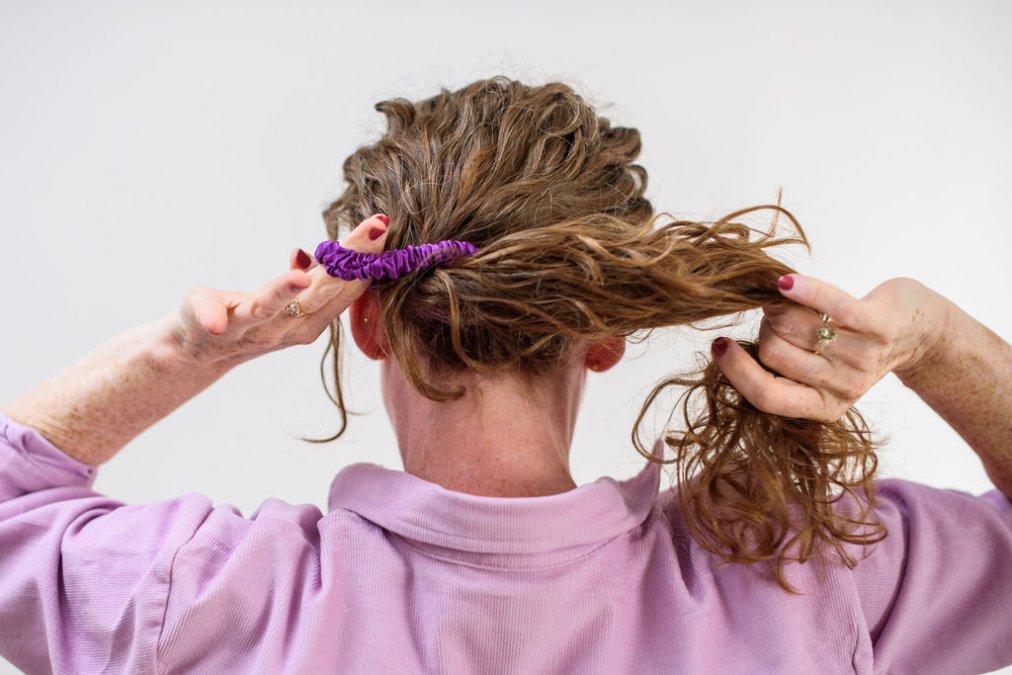
Close-up of a woman's hands wrapping a fabric hair tie around a ponytail
Step 1: Prep Hair With Grip-Boosting Products
Texturizing spray or dry shampoo adds friction at the root, giving the tie something to hold. Spray a light mist at the crown and mid-lengths, then rough up the roots with your fingertips. Skip heavy conditioner near the scalp on ponytail days, since it coats strands and reduces grip.
Step 2: Choose the Right Wrap Count for Your Hair Thickness
Wrap count is the single most overlooked fix. Too few wraps and the tie slides; too many and it strains the strands.
- Fine or thin hair: 3-4 wraps with a thin fabric tie
- Medium hair: 2-3 wraps
- Thick or curly hair: 2 wraps with a larger tie, or switch to a hair bungee
A hair bungee, which uses a hook instead of a loop, lets you adjust tension precisely and works well when standard wraps either slip or squeeze.
Step 3: Reinforce With Bobby Pins for Extra Security
Bobby pins lock a ponytail in place when a tie alone will not hold. Slide one pin into the base of the ponytail, ridges facing down, angled toward the crown. Cross a second pin over the first for a firmer anchor. This trick is especially useful for fine hair and for slicked-back styles.
Hair Type Tutorials: Curly, Straight, and Everything Between
Most guides stop at "fine hair slips, thick hair holds." That advice is too broad to act on. The variable that actually predicts whether a tie stays put is how your hair interacts with friction at the strand level, which comes down to porosity and curl pattern. Use the two questions below to find your category, then follow the matching routine.
Step 1: Identify Your Porosity
Porosity describes how tightly the outer layer of each strand is sealed. It controls how much moisture and product your hair absorbs, and therefore how slick or grippy it feels.
- Low porosity: the cuticle lies flat and tight. Hair feels smooth, products sit on top, and strands slide against each other easily. This is the hardest category to keep a tie on.
- Medium porosity: the cuticle is slightly raised. Hair holds product and friction well. This is the easiest category to secure.
- High porosity: the cuticle is raised and porous. Hair feels rough and dry, grips a tie almost immediately, but is also the most prone to snapping at the bend.
A quick at-home check: drop a clean strand in a glass of water. If it floats for several minutes, you are likely low porosity. If it sinks slowly, medium. If it sinks fast, high.
Step 2: Match Your Curl Pattern
Curl pattern changes where the tie sits and how much tension the strand can take.
- Type 1 (straight): the tie has nothing to anchor against, so grip must come from the tie material and prep products.
- Type 2 (wavy): the natural bend gives the tie a slight anchor. Two to three wraps with a fabric tie usually holds all day.
- Type 3 (curly): the tie grips well, but the bend point is fragile. Use fewer wraps and a seamless fabric tie to avoid creasing the curl.
- Type 4 (coily): hair holds a tie almost immediately, but the strand is dry and brittle. Gentle tension matters more than grip here.
Step 3: Apply the Combined Routine
Porosity + Pattern |
Wrap Count |
Tie Choice |
Key Adjustment |
|---|---|---|---|
Low porosity + Type 1 |
3-4 |
Ribbed fabric |
Texturizing spray at the root before wrapping |
Low porosity + Type 2 |
3 |
Ribbed fabric |
Light dry shampoo at the crown |
Medium porosity + Type 2 |
2-3 |
Fabric or modal silk |
No prep needed |
Medium porosity + Type 3 |
2 |
Seamless fabric |
Skip the spray, protect the curl |
High porosity + Type 3 or 4 |
2 |
Modal silk or satin-lined |
Leave-in conditioner at the ends, never at the root |
High porosity + Type 4 |
2 |
Modal silk |
Loose base, pin reinforcement instead of more wraps |
The Damage-Prevention Trade-Off
The instinct when a tie slips is to wrap tighter. For high-porosity and Type 3-4 hair, that instinct is exactly backwards. Tight wraps on dry, brittle strands cause the bend to crack, and repeated tension at the same spot can lead to traction damage over time. The fix is to increase friction at the surface, not pressure at the base. A textured fabric tie, a light root prep, and a bobby pin at the base will hold a ponytail with less tension than an extra wrap ever will.
Hair Tie Damage Prevention: Keep Grip Without Breakage
Hair tie damage prevention comes down to reducing traction and tension at the same time you increase grip. The goal is a tie that holds through friction, not through force.
Common mistakes that cause breakage:
- Wrapping too tight to stop slipping, which strains strands at the base
- Using metal-joined or glued elastics that snag and tear hair
- Leaving a tight tie in overnight
- Pulling the tie out instead of sliding it off gently
A tie with a smooth, seamless surface and a fabric grip lets you use less tension for the same hold. That is the core idea behind the modal silk and cotton ties from The Pretty Pretties: the material grips without the crushing pressure that dents hair and snaps strands. Rotating your ponytail position day to day also spreads tension across different strands.
DIY Hair Tie Modifications and Troubleshooting Sagging
Sagging usually has one of three causes: too few wraps, a stretched-out tie, or hair that is too slick for the material. Work through the diagnostic below in order, then use the DIY modifications if you want to salvage ties you already own.
Diagnostic: Why Is Your Ponytail Failing?
Symptom |
Most Likely Cause |
First Fix |
Second Fix |
|---|---|---|---|
Drops within an hour |
Too few wraps or slick hair |
Add one wrap |
Switch to ribbed fabric tie |
Holds at first, sags by afternoon |
Tie has lost elasticity |
Replace the tie |
Hand-wash and air-dry to restore |
Base feels loose but wraps hurt |
Tension is too high for the strand |
Remove one wrap |
Add a bobby pin at the base |
Ponytail sits low on the head |
Placement is off, not grip |
Re-position the base higher |
Use a bungee for adjustable height |
Tie slides but hair feels rough |
High porosity, dry strands |
Add leave-in conditioner at ends |
Switch to modal silk tie |
DIY Modifications for Ties You Already Own
These are simple fixes that add grip without buying anything new.
Add a silicone strip. Cut a thin strip from a silicone hair band or a piece of silicone caulk (fully cured) and stitch or glue it to the inside of a fabric tie. The silicone grabs smooth strands without adding tension. This works especially well on low-porosity, straight hair.
Texturize a smooth tie. Run a fine-grit nail file lightly along the inside of a coated elastic to rough up the surface. Go gently, a few passes is enough. Too much and you weaken the coating, which can snag hair.
Convert a stretched tie into a bungee. If a fabric tie has lost its stretch but the fabric is still intact, thread a hair bungee hook through it or use a small elastic loop as a replacement core. This gives you adjustable tension without the cost of a new bungee.
Double up for thick hair. Two thin fabric ties wrapped together distribute weight better than one thick tie. Wrap them as a single unit so the tension is even.
Restore elasticity. Hand-wash slack fabric ties in cool water with a drop of mild soap, squeeze gently, and air-dry flat. Never put elastic ties in a hot dryer, which breaks down the fibers and shortens their life.
Damage Prevention While You Troubleshoot
The goal of every fix above is to increase grip without increasing tension. If a modification makes the tie hold by squeezing harder, it is the wrong fix. The strands at the base of a ponytail are the ones that pay for excess tension, and repeated tight wrapping at the same spot is a common cause of breakage and thinning at the hairline. Rotate your ponytail position day to day, slide the tie off gently instead of pulling it, and never sleep in a tight tie.
Conclusion
A ponytail that stays put comes from matching material, texture, and tension to your specific hair, not from wrapping harder. Start with a textured fabric tie, prep with a grip-boosting product, and adjust your wrap count before you reach for more force.
The Pretty Pretties makes hand-dyed, biodegradable ties from modal silk and cotton that grip through surface texture, protecting hair from damage and denting while releasing a natural essential oil aroma. The durable, firm hold works across hair types and textures, and the ties are made by women-led teams through zero-waste production. For a hold that lasts without the breakage, shop the lavender set and make every ponytail an intentional ritual.
Frequently Asked Questions
Why does my hair tie keep falling out?
Hair ties slip for three main reasons: the material is too smooth (like basic elastic), your hair texture lacks natural friction, or you're not using enough wraps. Fine hair has fewer cuticle layers to grip, so silicone-lined or fabric ties work better. If your tie stretches out over time, it loses elasticity and needs replacing. For a secure hold, match the tie material to your hair type and adjust your wrap count based on thickness.
What are the best hair ties for fine hair that won't slip?
Fine hair needs ties with textured surfaces that create friction without pulling. Fabric-covered ties made from cotton or modal silk grip better than smooth elastics. Look for non-slip silicone grips or ribbed designs. Avoid thin, bare elastics that slide right out. The best hair ties for fine hair combine a soft outer layer with enough elasticity to hold a ponytail without requiring tight tension that causes breakage. Test by shaking your head gently after securing.
How do you keep a ponytail from sagging throughout the day?
Start with a texturizing spray or dry shampoo at the roots to add grip. Use a hair bungee or fabric tie instead of a basic elastic. Position the ponytail at the right height, then secure with two bobby pins crisscrossed at the base. For thick hair, use two ties: one for the initial wrap and a second for reinforcement. If sagging continues, your tie has likely lost elasticity. Replace it rather than over-tightening, which causes traction damage.
How can I secure a ponytail without causing hair damage?
Choose seamless, fabric-covered ties that distribute tension evenly. Avoid tight wrapping that pulls at the root. Alternate ponytail heights daily to prevent stress on the same strands. Use bobby pins with coated tips to prevent snagging. For hair tie damage prevention, never rip ties out; slide them down gently. If you feel tension headaches, your ponytail is too tight. A firm hold comes from material grip and proper wrap count, not excessive force.