
Best Damage-Free Hair Ties 2026: Top Gentle Picks
· Editorial Team

Table of Contents
- Why Hair Ties Cause Damage (And What to Look For)
- Best Damage-Free Hair Ties 2026: Top Picks
- How to Keep Hair Ties From Slipping
- Best Hair Ties for Thin Hair
- Hair Ties That Don't Leave Dents
- Materials That Prevent Breakage and Tangles
- How to Choose the Right Hair Tie for Your Hair Type
- Hair Tie Hygiene and Maintenance
- Frequently Asked Questions
Last Updated: September 19, 2026
Why Hair Ties Cause Damage (And What to Look For)
The wrong hair tie does quiet, cumulative damage: it grips too hard, pulls at the root, and grinds against the cuticle every time you adjust your ponytail, which is why damage free hair ties matter. This guide covers what causes breakage and which damage free hair ties are worth buying in 2026.
Traction Alopecia and Scalp Tension
Traction alopecia is hair loss caused by prolonged or repeated pulling tension on the follicle (the American Academy of Dermatology). It usually starts as thinning along the hairline or part line and is the most serious consequence of a too-tight ponytail.
Best Damage-Free Hair Ties 2026: Top Picks
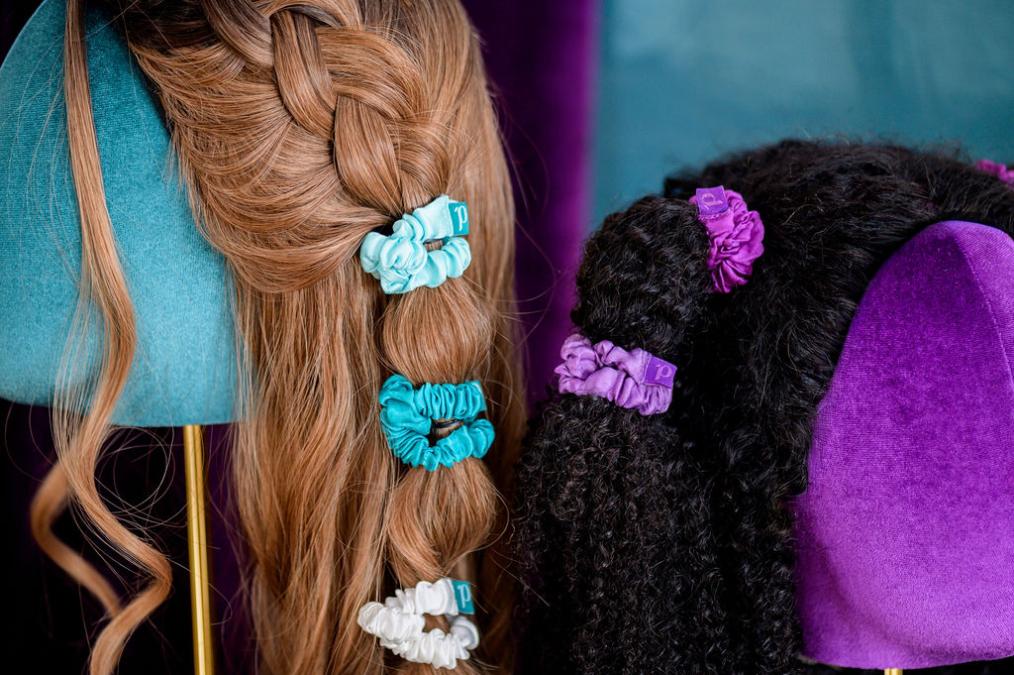
The best damage-free hair ties in 2026 are wide, seamless bands made from soft natural fibers that hold firmly without pinching. The Pretty Pretties makes our top pick, combining hand-dyed modal silk and cotton with a firm, tested hold for every hair type.

Set |
Scent |
Price |
Best For |
|---|---|---|---|
Lavender Serenity Set |
French lavender |
$40 |
Calm, daily wear |
Uplift Set |
Peppermint, eucalyptus, spearmint |
$40 |
Workouts, focus |
2-Pack Essential Oil Bundle |
Your choice of both |
$75 |
Gifting, stocking up |
Pretties Lavender Serenity Set
Our top overall pick. Each set includes five hand-dyed ties in white, lavender, purple, dark purple, and black, plus a custom lavender cosmetic case. The ombre finish is dye work, not printing, so no two ties look identical.
Pretties Uplift Set
The Uplift Set swaps lavender for peppermint, eucalyptus, and spearmint essential oils, designed to energize rather than calm. It comes in five hand-dyed teal ombre shades with a matching travel case.
2-Pack Essential Oil Bundle
Buying two sets together saves 10% and lets you mix lavender and Uplift, or double up on one scent. It arrives gift-ready.
How to Keep Hair Ties From Slipping
Keeping hair ties from slipping comes down to three things: band width, fiber friction, and how you wrap. A wide band with natural fiber grip holds better than a narrow elastic, even at lower tension.
Work through this checklist before blaming the tie:
- Choose a wide, seamless band instead of a thin elastic
- Avoid wrapping more than twice on fine hair, where extra wraps add tension without adding grip
- Anchor the tie at the base of the ponytail, not halfway up the back of the head
- Mist dry hair lightly before tying to add friction without soaking the band
- Replace any tie that has stretched out and lost its snap
Best Hair Ties for Thin Hair
The best hair ties for thin hair are soft, seamless bands with gentle grip and no metal join, because fine strands break at the slightest abrasion. Thin hair also shows dents faster, so surface texture matters as much as hold.
Hair Ties That Don't Leave Dents
Hair ties that don't leave dents are wide, smooth, and free of hard edges. A crease forms when a narrow band compresses hair against itself at one line; widen the contact area and the crease softens or disappears.
- Mist the creased section with water and smooth it with your fingers
- Blow-dry on low heat while pulling the section gently straight
- Switch the position of your ponytail each day so the same strands are not compressed twice
- Never tie hair while it is soaking wet, when strands stretch and snap more easily
Materials That Prevent Breakage and Tangles
Materials that prevent breakage share three traits: a smooth surface, natural fiber content, and seamless construction. Friction reduction is the goal, since rough edges catch the cuticle and cause tangling on removal, but "smooth" and "natural" get used loosely in marketing, so know what each material does at the strand level.
Silk vs. Satin vs. Elastic: What the Labels Really Mean
Silk is a protein fiber from silkworms with a naturally smooth surface and low moisture absorbency, so it does not pull water from the hair shaft the way cotton can. Satin is not a fiber but a weave, made from silk, polyester, or nylon, its smoothness comes from the pattern, not the material. A polyester satin scrunchie is smooth but plastic-based and will not biodegrade.
2 Pk of 100% Essential Oil Hair Ties →
Material |
Friction |
Holds Shape |
Biodegradable |
Best For |
|---|---|---|---|---|
Modal silk and cotton |
Low |
Yes |
Yes |
Fine, fragile, color-treated hair |
Silk satin (woven) |
Low |
Moderate |
Yes |
Sleep and overnight wear |
Polyester satin |
Low |
Yes |
No |
Budget smoothing, not eco |
Coated elastic |
Medium |
Yes |
No |
Everyday hold, thick hair |
Ribbed elastic |
High |
Fades |
No |
Short-term grip only |
Metal-join elastic |
High |
Yes |
No |
Avoid on fragile hair |
Seamless vs. Metal-Clasp Construction
A metal clasp or visible seam is a hard edge. Every time you slide the tie off, it scrapes the cuticle, the hair shaft's outer layer, lifting scales that catch and tangle. Over months, that abrasion starts split ends and mid-shaft breaks.
Why Natural Fibers Matter for Fragile Hair
Weakened hair, color-treated, heat-styled, or already breaking, has a raised cuticle that catches on anything textured. Natural fibers like modal silk and cotton slide over that surface instead of snagging it, making them the safer default for fragile hair. Coated elastics suit thick, resilient hair, but on fine or damaged strands the coating rarely offsets the narrow core.
How to Choose the Right Hair Tie for Your Hair Type
Choosing the right hair tie starts with density and texture, not color or brand. Match band width to your hair's mass, then pick a fiber that suits your routine, and mind sizing, since band diameter and thickness change how a tie behaves on different hair types.
A Sizing Guide by Hair Density and Texture
Hair typing runs from 1A (straight, fine) through 4C (tightly coiled, dense). A tie that works on 1A over-tightens on 4C, and one that anchors 4C slides off 1A. Here is how to match band specs to hair type:
Hair Type |
Density/Texture |
Band Diameter |
Band Thickness |
Fiber Priority |
|---|---|---|---|---|
1A-1B |
Fine, straight |
1.5-2 in |
Thin |
Modal silk/cotton, high grip |
1C-2B |
Medium, slight wave |
2-2.5 in |
Medium |
Modal silk/cotton or coated elastic |
2C-3B |
Wavy to curly |
2.5-3 in |
Medium-thick |
Smooth seamless, no ribbing |
3C-4A |
Curly to coily |
3-3.5 in |
Thick |
Wide seamless, low friction |
4B-4C |
Coily, dense |
3.5-4 in |
Thick |
Wide seamless, strong hold |
Match the Band to Your Routine
- Fine or thin hair: narrow-to-medium width, high-grip natural fiber, no metal join. Avoid over-wrapping, two loops maximum.
- Thick or coarse hair: wider band with stronger hold, since thin elastics will not anchor the mass and will need over-tightening.
- Curly hair: smooth, seamless band that slides off without catching coils; avoid ribbed elastics, which snag the curl pattern.
- Color-treated or fragile hair: modal silk and cotton to reduce friction on a weakened cuticle.
- High-intensity workouts: firm, tested hold that stays put through movement, plus a scent if you want the sensory lift.
The Size-Up Rule
If you are between sizes, size up. A slightly too-wide band still holds; a too-narrow band always needs over-tightening to stay in. Since over-tightening drives traction alopecia and ponytail headaches, erring wide is the safer mistake.
Why "One Size Fits All" Fails
A single band size cannot serve 1A and 4C hair: one needs grip without weight, the other width without slip. Brands selling one size optimize for the average, fitting almost no one perfectly. Matching diameter and thickness to your hair type turns a generic tie into a damage-free one.
Hair Tie Hygiene and Maintenance
Hair tie hygiene is the step almost every guide skips. Ties collect scalp oils, styling product, and shed hair, and a grimy band is a rough band.
Frequently Asked Questions
Which hair tie is the least damaging?
The least damaging hair ties are those made from smooth, natural materials like modal silk or organic cotton, which reduce friction and prevent snagging. Seamless construction is key because metal joins and rough edges catch on the hair cuticle, causing split ends and breakage. Look for ties that distribute pressure evenly across the ponytail rather than concentrating it in one spot, as this helps avoid scalp tension and traction alopecia. Damage-free hair ties should also hold firmly without requiring tight wrapping, which is where most breakage happens.
How do I choose a hair tie that doesn't leave dents?
To avoid dents, choose hair ties made from soft, thick fabrics that cushion the hair rather than crease it. Materials like modal silk and organic cotton are gentle enough to prevent deep indentations, even after hours of wear. Avoid thin elastic bands with sharp edges, which press hard into the hair shaft. Also, avoid tying too tightly; a firm but gentle hold is enough. Hair ties that don't leave dents typically have a wider, flatter profile that spreads tension across a larger area of hair.
What are the best hair ties for thick, curly hair?
Thick, curly hair needs hair ties with enough stretch and grip strength to hold without slipping, but without causing breakage. Look for ties made from durable material like modal silk or organic cotton that can handle volume without snapping. Seamless construction prevents snagging on curls, which are more prone to tangles. A firm hold is essential, so test the elasticity by stretching the tie gently. For extra security during workouts, choose a tie that stays put without needing multiple wraps, reducing friction and damage.
Do essential oil-infused hair ties actually protect hair?
Essential oil-infused hair ties do not directly repair damage, but they can support hair health by reducing the need for harsh elastics and adding a sensory calming or invigorating benefit. The microencapsulated oils release gradually, and the gentle materials (like modal silk or organic cotton) reduce friction and breakage. The main protection comes from the tie's construction: seamless, soft fabric that prevents snagging. The scent is a bonus for self-care, but the physical design is what protects your hair from damage.
How often should I replace my hair ties?
Replace hair ties when they lose elasticity, develop rough edges, or start to stretch out. A good quality tie made from durable material like modal silk or organic cotton can last months with proper care. Signs it's time to swap: the tie no longer holds firmly, it leaves dents more easily, or the fabric feels rough. To extend hair tie longevity, hand wash gently and air dry. Rotating between several ties also helps them last longer and keeps your hair protected.