
Non Denting Hair Ties for Curls: A How-To Guide
· Editorial Team

Table of Contents
- Why Non Denting Hair Ties for Curls Matter
- What You'll Need Before You Start
- Step 1: Match the Material to Your Curl Pattern and Porosity
- Step 2: How to Keep Hair Ties From Slipping Without Over-Tightening
- Step 3: Preventing Ponytail Damage on Curls
- Step 4: Best Hair Accessories for Curly Hair and How to Place Them
- Step 5: Care, Shrinking, and Nighttime Protection
- Common Mistakes to Avoid
- Frequently Asked Questions
Last Updated: September 27, 2026
Why Non Denting Hair Ties for Curls Matter
Non denting hair ties for curls are fabric-covered bands that hold coiled, wavy, and thick hair without leaving a crease or pulling strands tight enough to break them. This guide walks through the materials, sizing, and placement habits that keep your curl pattern intact.
Curls have a structural weakness straight hair doesn't: every bend in a coil is a stress point, and a thin elastic pinching that bend for hours weakens the strand right where it curves. The lingering crease is the visible half of the problem; the invisible half is cumulative damage from repeated tension at the same spot.
That's why the hair tie matters more for curly hair than any other texture, a gentle grip and wide surface area do more for hair integrity than any leave-in product.
What You'll Need Before You Start
You don't need much, but having the right items on hand keeps you from reaching for a drugstore elastic out of habit.
- Two or three fabric-covered ties in different widths
- A wide-tooth comb or your fingers for detangling
- A spray bottle with water for refreshing day-two curls
- A silk or satin pillowcase for overnight protection
- A small pouch or travel case to keep ties from stretching in a drawer
Work with hair that's damp or fully dry, never soaking wet, saturated curls stretch further and break at the crown.
Step 1: Match the Material to Your Curl Pattern and Porosity
Material choice decides whether a hair tie protects your curls or quietly damages them. Match the fabric to your curl pattern and porosity, and you solve most of the problem before you tie a ponytail.
Hair porosity is how readily your strands absorb and hold moisture, and it changes which fabrics work best.
Hosiery, Silk, Satin, and Polyblend Compared
Each material behaves differently against a coil. Here's how they stack up:
| Material | Friction Level | Best For | Watch Out For |
|---|---|---|---|
| Hosiery elastic | Low | Fine to medium curls | Stretches out fast; nylon covering can pill |
| Silk-lined | Lowest | High-porosity, fragile curls | Higher cost; silk loses luster with harsh soap |
| Satin-covered | Very low | Most curl patterns | Slippery on smooth hair; can slide during sleep |
| Polyblend | Moderate | Thick, heavy curls | Rougher weave can snag on split ends |
| Cotton-covered | Moderate-high | Low-porosity, coarse curls | Absorbs moisture from hair; dries out ends |
Matching Material to Porosity
- High porosity: Cuticles are lifted, so the strand surface is rough. Choose silk or satin to minimize friction. Avoid cotton, which absorbs the moisture your hair is already struggling to retain.
- Low porosity: Cuticles lie flat and the strand is smooth, so fabric is less likely to catch. You have more flexibility, polyblend and cotton-covered ties work well and give better grip than silk, which can slide.
- Medium porosity: Most curl patterns fall here. Satin-covered ties are the safest default; they balance low friction with enough texture to hold.
- Mixed porosity: Common on color-treated or heat-damaged curls, where ends are more porous than roots. Use a silk or satin tie and tie lower on the head so the band sits on healthier mid-lengths.
American Academy of Dermatology guidance on hair care and damage
Step 2: How to Keep Hair Ties From Slipping Without Over-Tightening
Learning how to keep hair ties from slipping comes down to surface friction and placement, not tightness. A tie that grips through fabric texture and correct positioning holds all day without strangling your roots.
- Switch to a wider band that spreads pressure across more hair
- Position the ponytail lower on the head, where there's less pull
- Wrap twice, not three times, and tuck the tail under the band
- Mist the hair lightly so it has a bit more grip
- Use a tie with a slightly textured outer weave if your hair is very smooth
Step 3: Preventing Ponytail Damage on Curls
Preventing ponytail damage on curls means limiting how often and how tightly you pull hair back, and varying where the ponytail sits. Curly hair is more fragile at the bend, so repeated tension in one spot adds up over months.
Pretties Scented Hair Ties | 100% →
Tension, Traction, and Long-Term Breakage
Traction damage builds slowly: one tight ponytail won't ruin your curls, but the same tight ponytail five days a week for a year can thin the hairline and weaken the mid-lengths.
- A sore scalp at the end of the day
- Small broken hairs around the hairline
- A ponytail that feels tighter than it looks
- Creases that stay visible for hours after removal
Step 4: Best Hair Accessories for Curly Hair and How to Place Them
The best hair accessories for curly hair share three traits: a smooth surface, a wide band, and enough stretch to hold without pinching. Placement matters just as much.
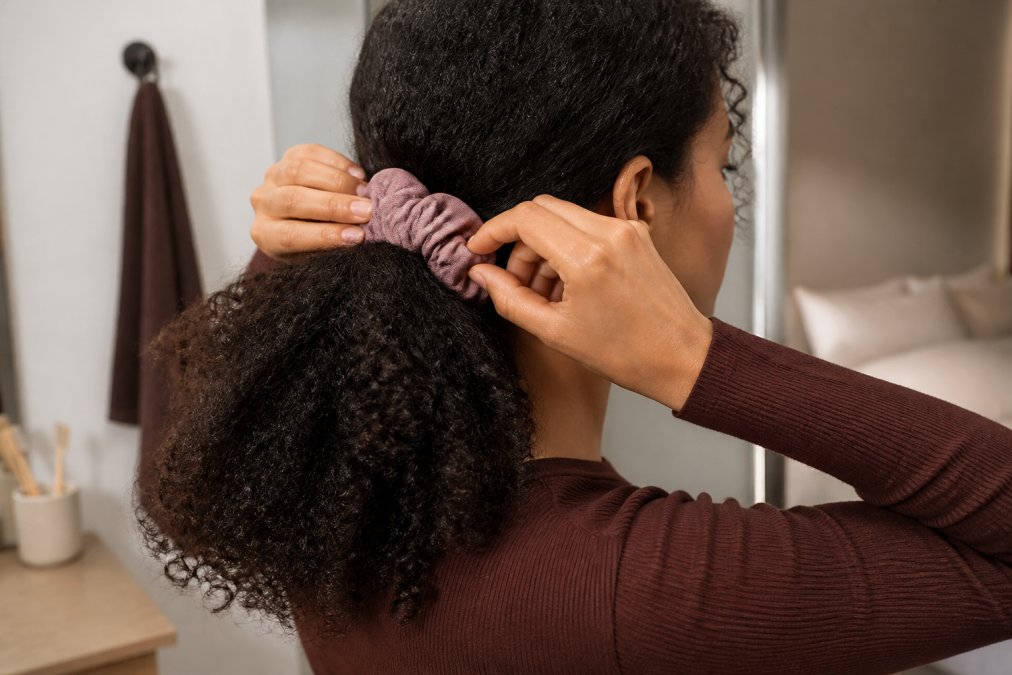
Placement rules that protect your curls:
- Gather hair loosely at the nape rather than pulling it up and back
- Keep the band off the crown, where tension causes the most thinning
- Avoid tying at the exact same height every day
- Leave a little slack so the tie isn't flush against the scalp
- Tuck the ends under rather than wrapping them tight
Step 5: Care, Shrinking, and Nighttime Protection
Hair ties stretch out over time, and how you care for them decides how long they last. A few habits keep the elastic working and the fabric smooth.
- Soak it in warm water for a few minutes
- Blot it dry and reshape it by hand
- Let it air dry fully before wearing
- Repeat once if the first round doesn't restore the stretch
Nighttime Protection: The Pineapple Method Done Right
Most curl damage happens at night. A tight ponytail worn for eight hours against a cotton pillowcase concentrates friction and tension at one point, which is why the hairline and crown thin first. The fix is a loose, high placement that keeps curls intact without pulling.
- Position the tie high enough that the ends fall forward over the forehead, not down the neck
- Use a silk or satin scrunchie rather than a polyblend, which can snag on dry ends overnight
- Never sleep in the same tight ponytail you wore during the day
- If your hair is short or layered, a loose bun at the crown works better than a pineapple
Common Mistakes to Avoid
Most curl damage from hair ties comes from a handful of repeat offenders. Stop doing these:
- Wrapping too many times. Three or four wraps create the tension that causes breakage. Two is usually enough with a wide band.
- Tying wet hair. Saturated curls stretch and snap more easily. Wait until hair is damp or dry.
- Using the same spot daily. Repeated tension in one place thins the hairline over time.
- Reaching for bare elastic. The uncovered rubber grabs and tears at cuticles.
- Sleeping in a tight tie. Overnight friction concentrates damage at one point.
- Ignoring the material. A rough polyblend on high-porosity hair will snag and split ends.
Frequently Asked Questions
What are the best hair ties that don't leave dents in my hair?
Fabric-covered options made from modal silk, cotton, or satin spread tension across a wider area than thin elastic bands, which is why they leave fewer creases. Look for snag-free, creaseless designs with a gentle grip and enough stretch to hold thick curls without pinching. Scrunchies and silk-lined or satin-covered ties work well for wavy, coily, and thick hair. Rotating between two or three ties and repositioning your ponytail each day also reduces repeat pressure in the same spot.
How do I keep hair ties from slipping out of curly hair?
Start with dry or mostly dry hair, since wet curls compress and loosen the hold as they dry. Wrap the tie two or three times depending on thickness, stopping before the band digs into your scalp. Choose a material with friction, such as cotton or modal silk, rather than smooth nylon. For workouts, a fabric-covered tie with a firm hold stays put better than a thin coil. If a tie still slides, size up rather than wrapping tighter.
Are silk or modal hair ties better for curly hair?
Both reduce friction compared with bare elastic. Modal silk is soft, breathable, and holds its shape well, which suits thick and coily hair that needs a firm but gentle grip. Silk tends to be smoother and lighter, which helps fine or wavy hair avoid creasing. The bigger factor is construction: a wide, fabric-covered band distributes tension better than a narrow one, so check the width and stretch before the fiber name.
How do I shrink stretched-out hair ties?
Fabric ties stretch over time, especially with heavy curls. A short soak in warm water, then air drying flat, can help cotton and modal blends return to shape. Avoid hot dryers, which break down elastic fibers faster. If a tie no longer snaps back after a few wears, retire it for nighttime braids or upcycling rather than doubling it up, since doubling increases tension and defeats the point of a non denting hair tie.